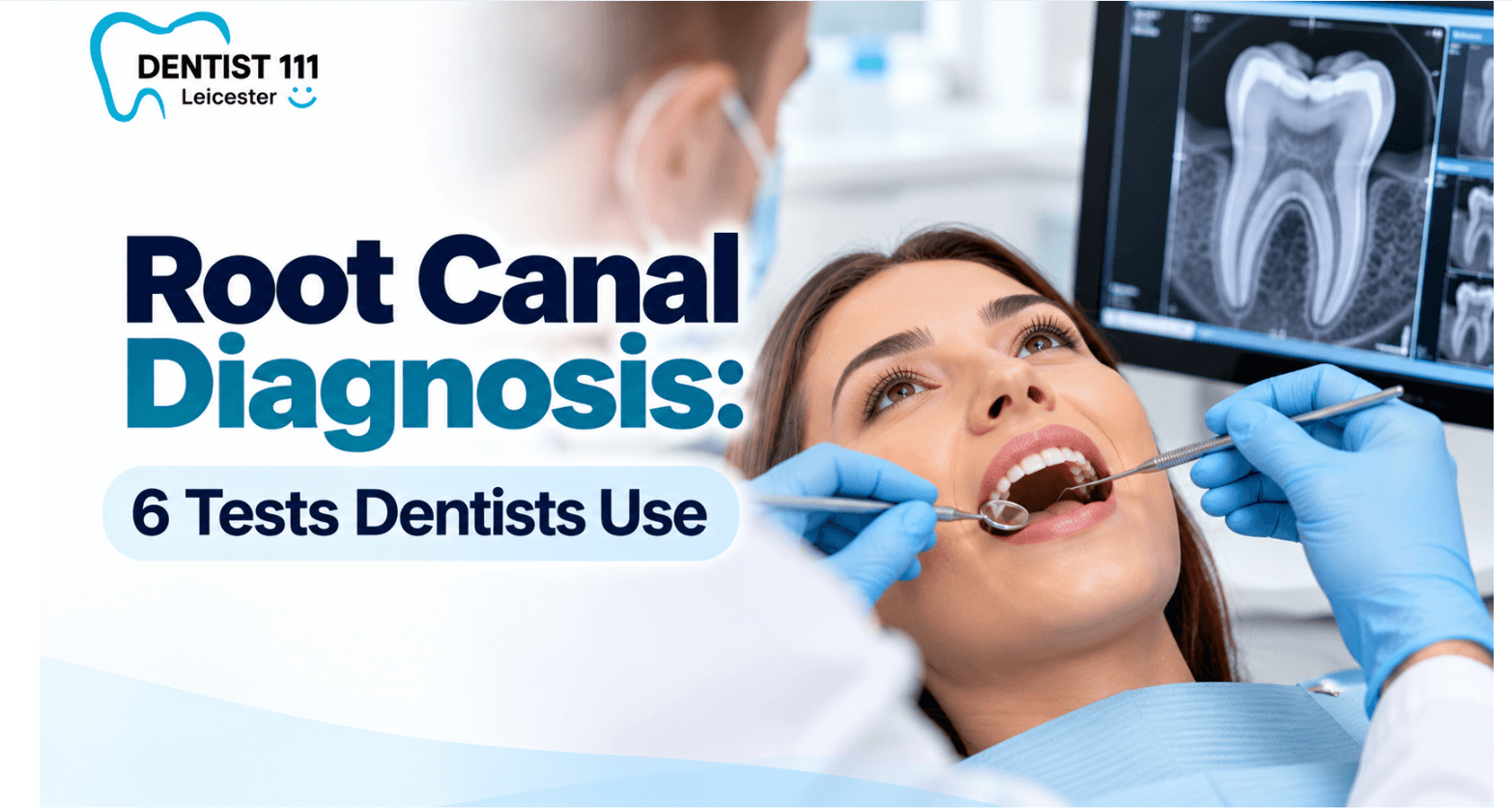
Root canal diagnosis starts with a review of the patient’s symptoms and dental history, followed by an examination of the affected tooth and surrounding tissues. The dentist may perform clinical tests and take dental X-rays when needed. By assessing these findings together, they can identify signs of pulp inflammation or damage and disease around the root. No single symptom or test can confirm the diagnosis on its own.
How Do Dentists Diagnose a Tooth That Needs Root Canal Treatment?
Dentists diagnose a possible root canal problem by reviewing the patient’s dental history, examining the tooth, performing appropriate clinical tests and assessing dental X-rays when needed. These findings help determine the condition of the dental pulp and the tissues surrounding the root.
1. Review Symptoms and Dental History
The dentist asks about the symptoms to understand when the problem started, what triggers the discomfort and whether it has changed over time.
Questions may cover:
- Pain onset and pattern: When the pain began and whether it occurs without an obvious trigger.
- Temperature sensitivity: Whether hot or cold foods and drinks cause pain and how long the discomfort lasts.
- Biting discomfort: Whether chewing or applying pressure causes pain.
- Previous dental treatment: Whether the tooth has a filling, crown or history of injury.
- Associated changes: Whether swelling or recurring symptoms have developed.
This information helps the dentist decide which tests are needed. The symptoms and dental history alone cannot confirm the diagnosis.
2. Examine the Tooth and Surrounding Tissues
The dentist checks the affected tooth and nearby tissues for decay, structural damage and signs of disease.
The examination may involve:
- Checking for deep decay, defective fillings or damaged crowns.
- Looking for cracks, fractures or discolouration.
- Examining the gums for swelling or a sinus tract.
- Checking periodontal pockets, tooth mobility or tenderness when appropriate.
- Examining nearby teeth to identify other possible sources of pain.
These findings help determine which tests to perform next. Visible damage or gum swelling does not, by itself, establish the condition of the dental pulp.
3. Test Pulp Sensibility
Cold and electric pulp tests check whether the sensory nerves inside a tooth respond to stimulation. They provide useful diagnostic information but do not directly measure the pulp's blood supply or establish its overall health.
Cold Pulp Test
The dentist applies a controlled cold stimulus to the tooth and compares the response with that of suitable control teeth. The presence, intensity and duration of the response help assess pulp sensibility.
A lingering response may support a diagnosis of pulp inflammation. An absent response may indicate reduced or absent sensibility, but it does not confirm pulp necrosis on its own.
Electric Pulp Test
An electric pulp test uses a controlled electrical stimulus to check whether the tooth's sensory nerves respond. The dentist interprets the result alongside the cold test and other clinical findings.
A positive response does not prove that the pulp is healthy. Likewise, a negative response alone cannot confirm that the pulp is dead.
4. Check for Tenderness, Bite Problems or Cracks
The dentist checks how the tooth responds to pressure and biting to look for possible problems involving the surrounding tissues or the tooth structure.
Tests may include:
- Percussion: Gently tapping the tooth to check for tenderness.
- Bite testing: Checking whether biting down or releasing pressure causes discomfort.
- Crack assessment: Examining the tooth for signs of a fracture.
- Palpation: Pressing the tissues over the root to check for tenderness when indicated.
Pain when tapping or biting may indicate inflammation around the root. However, similar discomfort can occur with a cracked tooth or other dental problems, so the result must be considered alongside the other findings.
5. Use Dental X-rays When Indicated
Dental X-rays help the dentist assess the roots, surrounding bone, deep decay and changes near the root tip. A periapical X-ray is particularly useful when disease around the root is suspected.
The images may reveal:
- Deep decay close to the pulp.
- Changes in the bone or tissues around the root tip.
- Existing restorations or previous root canal treatment.
- Root-related changes that are not visible during the clinical examination.
A normal X-ray does not rule out every early pulp problem. Similarly, a dark area near the root tip cannot establish the complete diagnosis on its own.
Three-dimensional imaging, such as cone beam computed tomography (CBCT), may be considered when conventional examination and imaging leave a specific diagnostic question unanswered. It is not routinely required for every suspected root canal problem.
The European Society of Endodontology recommends periapical radiography when diagnosing apical periodontitis. CBCT may be considered when diagnostic uncertainty remains.
6. Interpret the Findings Together
The dentist considers the history, examination, test results and imaging together to establish the most likely diagnosis and decide whether root canal treatment is appropriate.
The assessment considers:
- Pulp condition: Whether the findings indicate a healthy pulp, pulpitis or suspected pulp necrosis.
- Periapical condition: Whether disease affects the tissues around the root.
- Alternative diagnoses: Whether a crack, periodontal problem or nearby tooth could explain the symptoms.
- Tooth restorability: Whether the tooth can be predictably restored and preserved.
- Diagnostic uncertainty: Whether further testing, reassessment or an endodontist's opinion is needed.
Pulpitis is inflammation of the dental pulp, while pulp necrosis means the pulp tissue has died. Disease around the root may occur alongside pulp damage, but these conditions are not interchangeable.
Root canal treatment may be appropriate when the pulp is irreversibly inflamed or necrotic and the tooth can be restored. The decision depends on the complete clinical assessment, not on a single symptom or test result.
Can a Dentist Diagnose a Root Canal Problem Without an X-ray?
A dentist can assess pulp sensibility and look for clinical signs of a root canal problem without an X-ray, but imaging may be needed to examine the root and surrounding bone. Whether an X-ray is necessary depends on the suspected condition and the findings from the examination.
Cold and electric pulp tests show how the tooth responds to stimulation, while percussion checks for tenderness. These tests provide useful information, but they cannot show the full root structure or reveal every change in the surrounding bone.
If the diagnosis remains uncertain, the dentist may recommend imaging or further assessment before deciding on treatment. A normal X-ray does not rule out every early pulp problem.
Can Symptoms Alone Confirm That You Need Root Canal Treatment?
No, symptoms alone cannot confirm whether you need root canal treatment. Toothache, sensitivity to hot or cold, and pain when biting can indicate a dental problem, but these symptoms may also occur with tooth decay, cracks, gum problems or other conditions.
Some teeth with significant pulp damage may cause little or no pain. For this reason, the absence of toothache does not always rule out a problem inside the tooth.
A dentist assesses the symptoms alongside the clinical examination, pulp sensibility tests and dental X-rays when indicated. This helps determine whether the pulp is inflamed or damaged and whether root canal treatment is appropriate.
If you have persistent tooth pain or unexplained sensitivity, arrange a dental assessment rather than relying on symptoms to determine the cause. Understanding thesigns of root canal treatment may help you recognise when to seek professional advice..
What Happens If the Diagnosis Is Unclear?
If the diagnosis remains uncertain, the dentist may repeat tests, review the findings or arrange further assessment before recommending treatment. This helps reduce the risk of treating the wrong tooth or carrying out a procedure that may not be necessary.
Depending on the findings, the dentist may:
- Repeat selected tests: Check the tooth’s response to cold, electrical stimulation or pressure again if the initial results are inconclusive.
- Review dental X-rays: Assess whether the existing images provide enough information or whether further imaging is justified.
- Investigate other causes: Examine nearby teeth and check for cracks, gum problems or other conditions that could explain the symptoms.
- Monitor the tooth: Arrange a follow-up examination if observation is clinically appropriate.
- Refer to an endodontist: Seek a specialist’s opinion if the case is complex or the diagnosis remains uncertain.
Further imaging or specialist referral is not necessary in every unclear case. The next step depends on the suspected problem and what information the dentist needs to make a reliable diagnosis.
If the available findings do not explain your symptoms, the dentist may recommend further assessment before deciding whether root canal treatment is appropriate.
What Happens After the Dentist Confirms the Diagnosis?
Once the diagnosis is confirmed, the dentist explains what is happening inside the tooth and discusses the available treatment options. The recommendation depends on the condition of the pulp, the extent of the damage, the health of the surrounding tissues and whether the tooth can be restored.
Depending on the findings, treatment may involve:
- Root canal treatment: May be recommended if the pulp is irreversibly inflamed or has become necrotic and the tooth can be restored.
- Alternative dental treatment: May be more suitable if the problem is caused by decay, a crack or another condition that does not require root canal treatment.
- Further assessment: May be necessary if the diagnosis, extent of damage or restorability of the tooth remains unclear.
- Tooth removal: May be considered if the tooth cannot be predictably restored or preserved.
Before treatment begins, your dentist should explain the expected benefits, limitations and relevant risks of each suitable option.
A confirmed diagnosis does not automatically mean that a root canal is necessary. The decision depends on the clinical findings, whether the tooth can be preserved and your informed choice after discussing the available options with your dentist.
Frequently Asked Questions
What tests are used to diagnose a root canal problem?
Dentists may use cold and electric pulp tests, percussion, bite testing, a clinical examination and dental X-rays when needed. The tests selected depend on the suspected problem and the initial examination findings.
Does a positive cold test mean the tooth is healthy?
No. A positive response means the sensory nerves react to the cold stimulus, but it does not prove that the pulp is healthy. The dentist considers the result alongside the other examination findings.
Who diagnoses a root canal problem?
A general dentist can assess many dental conditions that may require root canal treatment. An endodontist, a dentist with advanced training in root canal treatment, may assess more complex cases or help when the diagnosis remains uncertain.
Need a Root Canal Assessment in Leicester?
Persistent toothache or sensitivity can indicate a dental problem. A dentist can examine the affected tooth, identify the likely cause and determine whether root canal treatment is appropriate.
Dentist 111 Leicester provides information aboutroot canal treatment, including the treatment options for an affected tooth.